
Elements

Over the past year I composed a piece for string quartet and electronics titled Elements in preparation for a short residency of the JACK Quartet at University of Virginia that I helped organize. The program notes for this piece read:

Elements follows the birth and death of a world through the lens of combinations of the four alchemical base elements: Earth, Water, Fire, and Wind.
The timid, then explosive formation of the Earth is followed by a presentation of the four base elements in their purest form. The base elements disappear, and as the activity subsides Water and Earth mix to form a slurry of rich, living activity. Wind returns, splitting the earth into ground and sky and catalyzing the activity of the Water into a chaotic force. The chaos builds to ignite Fire, which heats the Earth and scorches all life. A period of stasis follows, before a light haze rises, a memory of what used to be. The haze dries and falls to Earth, ending the piece.

This work consists of three layers: the material performed by the quartet, a fixed electronic composition, and a reactive, intermediary texture created through analysis of the performed material in real-time. An example of this last texture is a pizz. gesture triggering the playback of an audio file of a water droplet at a matching intensity level (dynamic, timbral valence).

This piece also makes some unique notational choices. All of the material of the piece is derived from a set of Gestures, Textures, and Transitions, the first page of which is below:

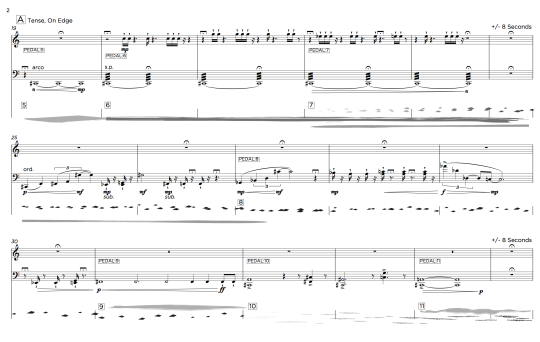
The first page of the score can be seen below, which has staves for the quartet, the Instrument Tone Extender (the interactive electronic component), and the fixed media part of the piece.

A recording of the piece performed by the quartet can be heard (and soon seen) below.

Splinters

This last year I responded to a call for works from the Parvenue Duo, a group consisting of Megan Kyle, oboe, (a classmate of mine at Oberlin) and Katie Weissman, cello, based in Buffalo, NY. The piece I composed for oboe, cello, and live electronics ended up being called Splinters.

This was my first venture into live electronics for performers other than myself (and was followed by Trio, described in this blog post) The live interaction is limited but effective. Any time that I was able to use fixed electronics (i.e. sound files) I did, but at three points in the piece the performer’s live input is recorded and granulated into clouds, creating chordal accompaniment from a monophonic sound source.

First use of live-granulation in _Splinters _(cue 7)

The piece has a number of different textures and relationships between the instruments and electronics. The work will be performed in Buffalo, NY and recorded by the Parvenue Duo in the fall.

UPDATE: here is a video of Parvenue Duo performing the piece:


Transference @ Third Practice Festival 2015

Video of a performance of my piece Transference for interactive video/audio performed by myself at the University of Richmond as part of the 2015 Third Practice Festival.

This piece utilizes the size, direction, and other heuristics about the performer's hands to trigger and manipulate the parameters of audio sources, which in turn are used to manipulate several animation scenes. Written in MaxMSP and Processing.

Leap Motion Toys

Video of myself playing with 4 Leap Motion Controller instruments I made to demonstrate electronic music to a middle school group.

The four presets are:

  • Piano (MIDI piano),
  • Recording (granular playback of several user-choosable audio files)
  • Synthesizer (FM params. mapped to 3D space)
  • Flies (resonant lowpass filter on 10 sawtooth oscillators, controlled by 10 fingers)
 

smallstep Album

What does musical activism mean to me?

In the middle of August of this summer I quickly completed a 30 minute album titled “smallstep”. The work is accompanied by a booklet designed by myself that explains the concepts behind each of the tracks and their source material (what recordings, pieces of music, and software I used to create the tracks).

You can listen here, and download for free here.

New York City Electroacoustic Music Festival

This week I’m staying in New York City for the New York City Electroacoustic Music Festival (NYCEMF). My piece Ring | Axle | Gear was broken into three parts (as I suggested) and programmed on 3 concerts (Tuesday afternoon, Friday afternoon, and Sunday evening). The quality of pieces in yesterday’s concerts was quite good, so hope that that trend continues. Also hoping to catch concerts and events outside of the NYCEMF while I’m here. Here is Ring | Axle | Gear in its entirety:


Sonic Arts Workshop

This week I’m in Oberlin for the Sonic Arts Workshop (SAW), a week-long, intensive electronic music workshop for high school students. The high school students this year have come from all over the US, including both coasts and Hawaii, and there is also one student who came from China. This is my third time teaching the workshop. I’m teaching a variety of classes ranging from microphone techniques, spectral processing, and audio programming. It’s a joy to work with such a variety of students in a nurturing and open environment.

Computer Music

Computer Music is an audio-visual installation that visualizes and sonifies computer processes.

The sonic component of the work is a mapping of the amount of memory used by and running time of the 100 most recent system processes onto the range of human hearing.

The visual component of the work takes the same data and displays it horizontally as a sequence of bars (with most recent processes on the left). Older and larger processes are displayed as brighter colors.

The installation is “performed” by the opening and closing of programs on the computer, with or without the intervention of a human user.

The goal of this work is two-fold: first, to bring the usually “silent”, backgrounded, computer processes people interact with everyday into a very perceptible, foregrounded, domain, and secondly, to do this in a way that reveals the beauty of these processes and how computer systems handle them.

Trombone Quartet

Over this summer I composed a trombone quartet titled “Acceptance” for the 2015 Third Coast Trombone Retreat. Here’s a video including a computer-generated recording and the score for the piece:

Update: Here’s the performance at the Trombone Retreat, quite well-played:

Niklas Roy

Niklas Roy is a self-proclaimed “inventor of useless things” from Berlin, but also an installation artist, robotics builder, and multimedia artist. The “inventor of useless things” description highlights the fact that a great deal of Roy’s work takes the engineering prowess and abilities needed for “useful” things and places them within the domain of art.

Roy’s work explores or redefines the boundaries between the real world (the world within which installation participants exist), the mechanical world (the physical materials of the installation), and the virtual, frequently digital world (the procedures and code that make the installation function). Roy’s installations often have an activist or humorous bent: exploring ideas of human’s relationships to virtual spaces, video games, art, privacy, energy usage, and more. Roy is also very open about his work, more often than not including source code or detailed descriptions of how things function in his projects.

The first work of Roy’s that I came across was My Little Piece of Privacy. This work involves a small curtain on a storefront window that moves left and right, in sync with people walking by on the street, actively blocking their gaze into the storefront. 

A contrasting work of Roy’s is Lumenoise, a fabricated “light pen which turns your old CRT-TV into an audiovisual synthesizer”. The result is a strange and wonderful instrument, with notably interesting visual patterns.

A work that I feel really epitomizes the tripartite exploration of participatory, mechanical, and digital space (this time only alluded to) is Pongmechanik, an electromechanical version of the early video game Pong.

Lastly, much of Roy’s recent work has focused on the use of multitudes of small balls in tubes, including the Pneumatic Sponge Ball Accelerator, a nod to the Large Hadron Collider, and an installation at the Goethe-Institut Krakau:

Roy’s creative fluidity within the fields of engineering, robotics, and visual and sonic arts is very inspiring.